

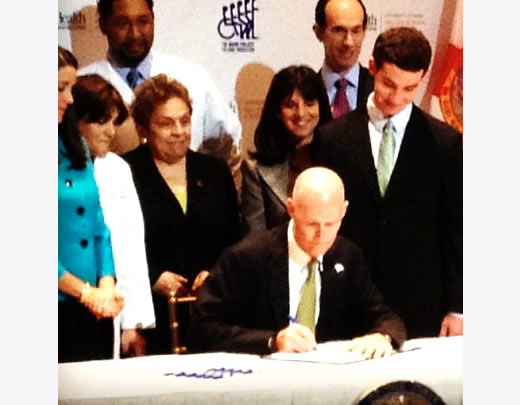
David Goldstein’s speech at the Bill Signing – 10/12/12
Good morning. Governor Scott, Senator Flores, President Shalala, Dean Goldschmidt, distinguished guests — Thank you very much for coming to this ceremony and supporting concussion awareness. My name is David Goldstein, and I am a twelfth grader at Ransom Everglades High School. Over the past two and a half years, I have been on quite a journey. It started with a frightful collision on a soccer field, has consisted of many struggles and obstacles, and is culminating in a truly special event here today to celebrate Florida’s new concussion law. I stand here before you to share what I went through and the work that I have done.
I suffered three concussions playing soccer in a span of four years. My most recent concussion, which occurred in January, 2010, resulted in three and a half months of relentless pain. I was sensitive to light and sound, my balance was distorted, I was depressed, and my head hurt so badly that I had to sleep in the nurse’s office most days in order to get through school. Hopelessness engulfed me, for every doctor I visited told me that my torment could not be alleviated, that all I could do was wait and that I should never play soccer again.
After months of searching for help, my family found Dr. Gillian Hotz and Dr. Kester Nedd at University of Miami Sports Medicine Clinic. They applied their concussion treatment expertise to my injury, and turned my life around. After living through months of agony, I reached recovery thanks to Dr. Nedd and Dr. Hotz. I cannot thank them enough for helping me to be symptom-free and able to be myself again. I am incredibly excited to begin my senior year of soccer as Ransom Everglades’ team Captain next month.
Having fully recovered, I looked back on my experience and made a decision: I wanted to do everything possible to protect youth athletes from suffering the way I did. Since that decision, I have promoted concussion awareness. The first step was to spread the ImPact baseline concussion test to Miami-Dade’s high school sports teams. I am proud that Miami-Dade County is the first county in the United States to implement the test in all of its public high schools. I would like to thank Ransom Everglades for its support of my efforts to achieve county wide concussion care.
My efforts on the local scale led to my involvement in the effort to pass youth concussion legislation at the state level. Our first attempt to secure this legislation was unsuccessful, and I received a rude awakening to the reality of politics. However, Senator Flores spearheaded a second effort to pass this essential legislation, and our persistence paid off when the legislation passed unanimously in both houses of the Legislature in this year’s session. All the letters to the Senators and Representatives, the trips to Tallahassee to meet with key legislators and my appearances before the House and Senate Committees of reference had paid off.
Senator Flores and Representative Renuart deserve praise for the tireless work they put into passing this legislation and for their commitment to Florida’s youth athletes. I would also like to thank Nelson Diaz and Lindy Kennedy for their guidance and persistence that made success possible.
The efforts of our team already have transformed the way that Floridians think about concussions. Floridians now have a greater understanding of the serious dangers of concussions. The NFL has played a substantial role in the promotion of concussion education, for it has spread its initiative to protect athletes from concussions to the youth athletes of Florida and the rest of the country. The guidelines that the Florida High School Athletic Association has created under the umbrella of the legislation will guide coaches, trainers, referees, and others in the rules for removal from play and return to play. The result of all of this progress is that I have realized a major step towards my goal – there is a reduced danger that Florida’s youth athletes will suffer what I suffered from my concussions.
I would also like to mention the research being done at the KiDZ Neuroscience Center at the Miami Project to Cure Paralysis. This research strives to shed further light on the consequences of impacts to the head on the brain. I truly appreciate the interest that Marc Buoniconti has taken in my work and the serious issue of concussions.
I will now direct my conclusion towards Governor Scott. Governor, your support of this bill has been immensely appreciated. It means a lot not just because it demonstrates your concern for the well-being of the youth athletes of our state, but also because you are here today during a time when so many issues are fighting for your attention. Thank you once again for your commitment to spreading concussion awareness, and thank you, to all who are here today, for sharing this special day with me.

Governor Scott with David Goldstein
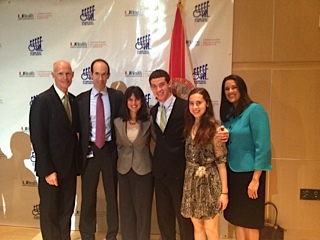
Governor Scott Celebrates State’s New Concussion Protections at Miami Project
Recognizing the contributions of UM’s concussion experts and a high school soccer player lucky enough to be one of their patients, Governor Rick Scott visited The Miami Project to Cure Paralysis last week to officially sign into law a bill designed to safeguard Florida’s youth athletes from the potentially devastating consequences of brain injuries suffered on the playing field.
Spearheaded by a state task force led by Gillian Hotz, Ph.D., research professor of neurological surgery and director of UM’s Concussion Program, and sponsored by state Senator Anitere Flores of Miami, the law bars young athletes who endure concussions from returning to practice or play until they are cleared by a physician. It also requires parents to sign informed consent forms acknowledging they are aware of the risks of concussion.
“Too many times we hear stories of our athletes being told, ‘Hey, you just got a bump on the head. Shake it off, and get back in the game because we really need you,’’’ Flores said. “Unfortunately, years down the line, we see the issues.”
Hotz, director of the KIDZ Neuroscience Center, helped build UM’s Concussion Program into a national model for concussion management, research, training and education. She said school-age athletes too often suffer long-term cognitive, physical and psychological impairments by returning to play too soon after a bump or blow to the head, or after multiple concussions. “Concussion is a national epidemic,” she said.
Both she and Flores credited David Goldstein and his parents, Cheryl and Adam, for the celebratory October 12 bill-signing ceremony proudly attended by UM President Donna E. Shalala, Miller School Dean Pascal J. Goldschmidt, M.D., Miami Project founder Barth A. Green, M.D., professor and chair of neurological surgery, and a host of dignitaries. Now a high school senior and captain of the soccer team at Miami’s Ransom Everglades School, David suffered his third concussion in four years in January 2010, just as Hotz launched the state task force to push for passage of the concussion bill.
After nearly four months of relentless pain, sensitivity to light and deep despair over being told no one could allay his symptoms and he’d never play soccer again, David and his parents found Hotz and Kester Nedd, D.O., voluntary associate professor of neurology and Medical Director of the Concussion Program at UM’s Sports Medicine Clinic. “They applied their concussion expertise to my injury and turned my life around,” David said. “I cannot thank Dr. Hotz and Dr. Nedd enough for helping me be symptom-free and able to be myself again.”
Determined to help other students avoid the torment he endured, David launched a concussion awareness and fundraising campaign at Ransom to ensure all Miami-Dade County public high school athletes undergo a baseline ImPACT test, a computerized neurocognitive evaluation that can be used to assess post-injury cognitive function. Today, Miami-Dade is the first county in the nation to provide the test to all high-schoolers who play contact sports.
He also spent countless hours pushing for passage of the concussion bill, receiving “a rude awakening” when it was defeated last year. But on Friday, his persistence paid off as he watched Governor Scott sign the legislation.
As Miami Project President Marc Buoniconti quipped in expressing his admiration for David, “Watch out for this kid, Governor. … He may have your job soon.”
President Shalala joked that she’d gladly give her job to David, and told the audience that Lee Kaplan, M.D., Chief of the Division of Sports Medicine and Medical Director and Head Team Physician of UM Athletics, and his team rightfully have more power at UM than she does. “If they say you can’t play, if they say you have to come in and see them … no one can overrule them,” she said.
Dean Goldschmidt expressed his gratitude to Hotz and other concussion researchers and bill advocates for ensuring that coaches, athletic trainers, parents and students will take head injuries seriously. “I applaud all of those who are contributing to this extremely important mission,” he said.
Thanking Hotz, Green, and all of UM for its “admirable” work, Scott dedicated the new law to Daniel Brett, a Broward County high school freshman who took his own life after enduring two years of long-term effects, including dizziness, mood swings and migraines, following multiple concussions playing football. His mother is now working with Broward Schools to bring baseline ImPACT testing and education to high school athletes.
“This bill cannot bring Daniel back,” Scott said, “but it will live in his memory and hopefully protect the health and welfare of other students for generations to come.”

High school athlete turns injury into crusade for better treatment of concussion injuries around state
Sunday, August 05, 2012
by Hal Habib
David Goldstein, shown speaking in Tallahassee, has fought to make it illegal for virtually any high school or youth league in Florida to allow a child to return to practice or play if he’s suspected of suffering a traumatic brain injury without first receiving written medical clearance. (Photo courtesy Countywide Concussion Care)
NOTE: This is the second in a two-part series.
Part 1: After son’s tragedy, S. Fla. mother strives to reduce football concussions in youths
The story of David Goldstein begins like many — make that too many — young athletes.
One concussion was followed by another, then a third. If they were scary, the way he handled them, in retrospect, was more frightening. He played two full soccer matches immediately following the second concussion because it was State Cup weekend in Wellington. He didn’t come out of the match following his third concussion because it was a high school district title match. He figured his team needed him.
Disconcerting as that is with what we know about concussions today, David Goldstein, 17, would be the first to say none of that makes his story unique. Kids suffer concussions every day, he points out.
No, what happened next does make Goldstein’s story unique.
First, he got better under the guidance of two University of Miami physicians who have become leading experts on such injuries.
Then, he got going. Convinced by doctors Gillian Hotz and Kester Nedd that baseline testing is an important tool in protecting athletes, he worked to make the test available at his school, Miami-Ransom Everglades. Next, recognizing that public schools in Miami-Dade County aren’t afforded the benefits that private schools enjoy, Goldstein decided to raise $20,000 to introduce the cognitive test to all public schools in Dade.
Still not enough.
Zeroing in on state laws, he fought to make it illegal for virtually any high school or youth league in Florida to allow a child to return to practice or play if he’s suspected of suffering a traumatic brain injury without first receiving written medical clearance. It also requires informed consent to play.
He’s also determined to make baseline testing standard throughout Florida even if it means working county by county, a push that likely helped inspire Palm Beach County schools this year to follow Dade and Broward’s lead.
To say Goldstein’s efforts went just as planned isn’t quite accurate. The bill he championed initially was defeated in the state legislature but his persistence was rewarded when Gov. Rick Scott signed it into law in April. David monitored passage of the bill via computer at school, success etched so clearly across his face that students he didn’t even know were high-fiving, hugging and applauding him. The vote was unanimous.
Oh, and he did not raise $20,000. He raised close to double that.
“My doctors’ motivation to help other people through their research kind of made me realize that I have an opportunity,” Goldstein says. “That I can be the face of local efforts and try to expand them because I’ve gone through it. I was willing to put my face out there. I was willing to go out and raise the money that no one else had time to raise.”
Marc Buoniconti, president of The Miami Project to Cure Paralysis, describes Goldstein as remarkable and selfless.
“David has just been a great ally in this initiative,” Buoniconti says. He works with Goldstein through The Miami Project’s KiDZ Neuroscience Center, which researches traumatic brain injuries because they’re closely associated to spinal cord injuries. “He’s so well-spoken and his story is so dramatic and so spot-on, that it just goes to show you a kid like David, a young kid, is just a great role model.”
Goldstein, whose family lives in Buoniconti’s former Coral Gables home, left an impression on Sen. Anitere Flores, R-Miami, who sponsored Goldstein’s bill. David sought to shed light on a dark, often confounding condition. He didn’t want other kids to experience the partial diagnoses, of being told to never play sports again, of needing to nap in the school nurse’s office because of headaches, fatigue and nausea — what he endured before meeting Hotz and Nedd.
“He recognizes that he is incredibly blessed with family support, and rather than sit back and say ‘good for me,’ he’s gone into communities locally and across the state advocating for what he knows will save lives,” Flores said via e-mail. “I can go on and on because David is that special. I’ll just end by saying that the world needs to keep an eye on David Goldstein because his talent and commitment is far from being exhausted!”
It hasn’t been without a price. Goldstein, a senior who is expected to be Ransom’s captain, is easily distinguishable on the field.
“I actually wear a rugby helmet when I play soccer now, which may not be the greatest fashion statement in the world, but it allows me to play the sport that I love,” he says.
Opposing fans, who have no idea what’s behind the helmet, make him a target.
“Some of the abuse I’ve heard would not be approved by the FCC — not even close,” he says. “I’ve heard some of the meanest things that I’ve ever heard in my life directed at me just for wearing a helmet. … Parents yelling ‘special ed’ at me. And you’ve just got to have the mental and emotional fortitude to realize that those people just don’t matter in your life.”
Cheryl Goldstein, his mother, admits it can be tough to hear.
“You look at this world and you look at how cruel people can be and I’m glad that David is tough enough, at least on the outside, to take it,” she says. “But it impacts him on the inside, as he’s human. I just hope that there’s a lesson in tolerance.”
Like Cheryl, David has testified before the state legislature.
“He felt comfortable to talk about it publicly, which is not something that a lot of children would be willing to do, because obviously he’s talking about problems that he had in his head,” says his father, Adam.
Flores says David not only caught on to the political process quickly, “he dominated it.” She adds, “He wouldn’t take no for an answer. He would fight half truths and misstatements from the other side with facts and figures in a methodical way.”
Adam Goldstein is president and CEO of Royal Caribbean International, but even though a cruise was the grand prize in a drawing that raised the initial $8,000 at Ransom-Everglades, Adam and Cheryl had David go through standard channels to obtain that donation.
“I admit that we are fortunate to know people who have the means to make contributions and who certainly are charitable in other areas of life, but he needed to sit down with every person who contributed to him and explain in person — without us there — what he was doing, why he was doing it and to ask them for money,” Adam says.
David: “It’s definitely a welcome-to-the-real world experience. Usually when I’m talking to adults, in a sense, I’m asking them for help on my homework. I’m not asking them for as much money as they’re willing to give me.”
Nervous? Not really. His cause “almost gave the people I was asking for money no choice” but to help, he says. “When you have passion about anything, it’s an invaluable tool.”
Goldstein, an A student in honors classes, hopes to attend Princeton, his father’s alma mater, and perhaps someday coach. He says until he meets with those who have backed him, he’s unsure of his next steps in the concussion fight … yet in the next breath, he rattles off that he must make sure Dade’s baseline program is self-sufficient for when he leaves for college. He’s got to continue educating coaches, parents and athletes. He has youth organizations to get onboard. Work on his site, countywideconcussioncare.com. Et cetera.
“Kids are getting concussions today,” he says. “They’ll be getting concussions tomorrow. They’ve gotten concussions yesterday. In Florida. All over the country. All over the world. And they don’t know who to turn to.
“They’re going back into the game too early. Second-impact syndrome is happening. People are researching more about CTE — these tragedies keep occurring in NFL players. There’s still more work to be done.
“I’m very happy with what I’ve been able to do but I’m not done and don’t intend to be for a while.”
Says Buoniconti: “I would watch that kid in the future.”

Blog Update – Success!
 The Youth Concussion Legislation has officially been signed into law by Florida Governor Rick Scott! The dream of spreading youth concussion education and management has now officially become a reality! All obstacles have been overcome, and everyone involved in Florida youth athletics should celebrate! A new era of player safety has now begun in Florida, and hopefully the passing of this legislation will inspire further efforts and legislation aimed at making the youth athletic environment safer throughout counties, states, and the entire nation. Thank you for all of the support and encouragement that I have received, and I hope to report more good news in the near future!
Blog Update
WE DID IT!!! After a year and a half of hard work and perseverance, the Youth Concussion Legislation unanimously passed through the Florida Senate and House of Representatives! All Florida youth athletes will now be better protected from concussions. Thank you so much to everyone who has supported me through my concussions, my work as a concussion awareness advocate, and the legislative process. We could not have done it without you, and we are so happy and relieved! A special thank you to Senator Anitere Flores and Representative Ronald “Doc” Renuart for their sponsorship of the bill and the tremendous amount of effort they put forth in order to get it passed. Another special thank you to Kenneth Edmonds of the NFL, who represented the league’s support of the legislation throughout the legislative process.